Structured entries
- EXITING THE FACTORY
Lumière, France 1896, 1:13. Music for Exiting the Factory and Card Party by Neil Brand.
- ARRIVAL OF A TRAIN
Gaumont, France, 1897, 0:48. Music for Arrival of a Train by Eric le Guen.
- CARD PARTY
(hand-colored) - Lumière, France, 1896, 1:26. Lobster Films purchased the original Lumiere-perforation negatives of Workers Leaving the Peugeot Factory and fifty other titles at an auction in Lyon for about fifty U.S. dollars.
- KOBOLKOFF
France, 1900, 1:24. Filmed about 1900, here is the famous man-torso, Nikolai Kobolkoff, born in Siberia (1851) and a performer beginning in 1874.
- DANSE SERPENTINE
(in a Lion's Cage) (hand-colored) - France, 1900, 2:08. The famous serpentine dance was originated by modern dance pioneer Loie Fuller and soon widely imitated in both American and European vaudeville.
- CYRANO DE BERGERAC
w/ Coquelin Aîné
(hand-colored, sound on cylinder) - Phono-Cinéma-Théâtre, 1900, 1:55. Probably the first color and sound film, the duel scene from Cyrano de Bergerac, was filmed by Clement-Maurice.
- LA MARSEILLAISE
w/ M. Noté of the Paris Opera
(sound on disc) - Georges Mendel, France, 1907, 2:41. Here, M. Noté of the Paris Opera sings La Marseillaise in 1908.
- EXCELSIOR! - PRINCE OF MAGICIANS
Georges Méliès, France, 1901, 2:06. French stage magician and illusionist Georges Méliès began filmmaking in 1896.
- THE FALLEN PUNISHMENT
(stencil-colored) Pathé Frères, France, 1906, 4:35. The Fallen Punishment was made in 1906 by Gaston Velle, a specialist in fantasy films.
- KIRIKI, JAPANESE ACROBATS
(hand-colored) Pathé Frères, France, 1907, 2:38. Kiriki, Japanese Acrobats was made for Pathé Frères in 1907 by Segundo de Chomon.
- AN EXCURSION TO THE MOON
(stencil-colored) Pathé Frères, France, 1908, 6:47. Georges Méliès' best-known film, A Trip to the Moon, is inspired by Jules Verne's "From the Earth to the Moon" and H. G. Wells' "First Men on the Moon."
- THE AUTOMATIC MOVING COMPANY
Pathé Frères, France, 1911, 4:23. Historian Donald Crafton credits this 1911 Pathé Frères film The Automatic Moving Company to Romeo Bosetti.
- THE SEINE FLOOD
Eclipse, France, 1910, 4:16. These long-forgotten images of The Seine Flood, which devastated Paris in late January, 1910, were miraculously found only recently.
- OVER THE TOP
(A Battle With the Elements) - Earle Films, USA, 1915, 11:22. In 1915, the Reno Commercial Club offered a trophy for the first car to travel a new route from San Francisco to Reno.
- A VISIT TO LOS ANGELES
Ford Motor Company, USA, 1916, 10:25. To popularize the idea of automobile travel, Ford Motor Company produced Ford Educational Weekly.
- MONTMARTRE'S KIDS
France, 1916, 3:51. Montmartre's Kids, also from 1916, was filmed on the Parisian hill.
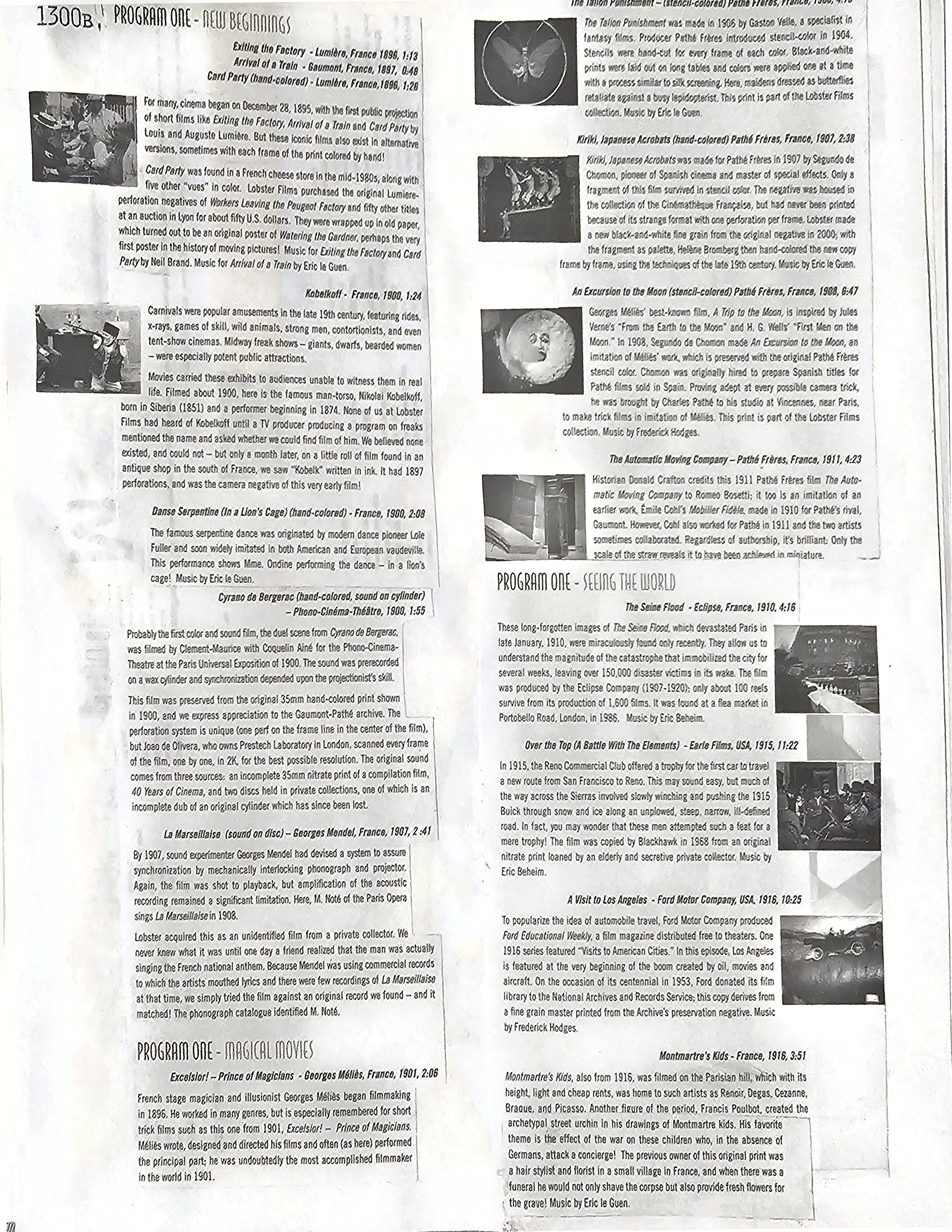
Transcription (raw)
## HEADING: 1300B PROGRAM ONE - NEW BEGINNINGS
## LEFT COLUMN
Exiting the Factory - Lumière, France 1896, 1:13
Arrival of a Train - Gaumont, France, 1897, 0:48
Card Party (hand-colored) - Lumière, France, 1896, 1:26

For many, cinema began on December 28, 1895, with the first public projection of short films like Exiting the Factory, Arrival of a Train and Card Party by Louis and Auguste Lumière. But these iconic films also exist in alternative versions, sometimes with each frame of the print colored by hand!

Card Party was found in a French cheese store in the mid-1980s, along with five other "vues" in color. Lobster Films purchased the original Lumiere-perforation negatives of Workers Leaving the Peugeot Factory and fifty other titles at an auction in Lyon for about fifty U.S. dollars. They were wrapped up in old paper, which turned out to be an original poster of Watering the Gardener, perhaps the very first poster in the history of moving pictures! Music for Exiting the Factory and Card Party by Neil Brand. Music for Arrival of a Train by Eric le Guen.

Kobolkoff - France, 1900, 1:24

Carnivals were popular amusements in the late 19th century, featuring rides, x-rays, games of skill, wild animals, strong men, contortionists, and even tent-show cinemas. Midway freak shows -- giants, dwarfs, bearded women -- were especially potent public attractions.

Movies carried these exhibits to audiences unable to witness them in real life. Filmed about 1900, here is the famous man-torso, Nikolai Kobolkoff, born in Siberia (1851) and a performer beginning in 1874. None of us at Lobster Films had heard of Kobolkoff until a TV producer producing a program on freaks mentioned the name and asked whether we could find film of him. We believed none existed, and could not -- but only a month later, on a little roll of film found in an antique shop in the south of France, we saw "Kobelk" written in ink. It had 1897 perforations, and was the camera negative of this very early film!

Danse Serpentine (in a Lion's Cage) (hand-colored) - France, 1900, 2:08

The famous serpentine dance was originated by modern dance pioneer Loie Fuller and soon widely imitated in both American and European vaudeville. This performance shows Mme. Ondine performing the dance -- in a lion's cage! Music by Eric le Guen.

Cyrano de Bergerac (hand-colored, sound on cylinder)
- Phono-Cinéma-Théâtre, 1900, 1:55

Probably the first color and sound film, the duel scene from Cyrano de Bergerac, was filmed by Clement-Maurice with Coquelin Aîné for the Phono-Cinema-Theatre at the Paris Universal Exposition of 1900. The sound was prerecorded on a wax cylinder and synchronization depended upon the projectionist's skill.

This film was preserved from the original 35mm hand-colored print shown in 1900, and we express appreciation to the Gaumont-Pathé archive. The perforation system is unique (one perf on the frame line in the center of the film), but Joao de Oliveira, who owns Prestech Laboratory in London, scanned every frame of the film, one by one, in 2K, for the best possible resolution. The original sound comes from three sources: an incomplete 35mm nitrate print of a compilation film, 40 Years of Cinema, and two discs held in private collections, one of which is an incomplete dub of an original cylinder which has since been lost.

La Marseillaise (sound on disc) - Georges Mendel, France, 1907, 2:41

By 1907, sound experimenter Georges Mendel had devised a system to assure synchronization by mechanically interlocking phonograph and projector. Again, the film was shot to playback, but amplification of the acoustic recording remained a significant limitation. Here, M. Noté of the Paris Opera sings La Marseillaise in 1908.

Lobster acquired this as an unidentified film from a private collector. We never knew what it was until one day a friend realized that the man was actually singing the French national anthem. Because Mendel was using commercial records to which the artists mouthed lyrics and there were few recordings of La Marseillaise at that time, we simply tried the film against an original record we found -- and it matched! The phonograph catalogue identified M. Noté.

PROGRAM ONE - MAGICAL MOVIES
Excelsior! - Prince of Magicians - Georges Méliès, France, 1901, 2:06

French stage magician and illusionist Georges Méliès began filmmaking in 1896. He worked in many genres, but is especially remembered for short trick films such as this one from 1901, Excelsior! - Prince of Magicians. Méliès wrote, designed and directed his films and often (as here) performed the principal part; he was undoubtedly the most accomplished filmmaker in the world in 1901.

## RIGHT COLUMN
The Fallen Punishment - (stencil-colored) Pathé Frères, France, 1906, 4:35

The Fallen Punishment was made in 1906 by Gaston Velle, a specialist in fantasy films. Producer Pathé Frères introduced stencil-color in 1904. Stencils were hand-cut for every frame of each color. Black-and-white prints were laid out on long tables and colors were applied one at a time with a process similar to silk screening. Here, maidens dressed as butterflies retaliate against a busy lepidopterist. This print is part of the Lobster Films collection. Music by Eric le Guen.

Kiriki, Japanese Acrobats (hand-colored) Pathé Frères, France, 1907, 2:38

Kiriki, Japanese Acrobats was made for Pathé Frères in 1907 by Segundo de Chomon, pioneer of Spanish cinema and master of special effects. Only a fragment of this film survived in stencil color. The negative was housed in the collection of the Cinémathèque Française, but had never been printed because of its strange format with one perforation per frame. Lobster made a new black-and-white fine grain from the original negative in 2000; with the fragment as palette, Hélène Bromberg then hand-colored the new copy frame by frame, using the techniques of the late 19th century. Music by Eric le Guen.

An Excursion to the Moon (stencil-colored) Pathé Frères, France, 1908, 6:47

Georges Méliès' best-known film, A Trip to the Moon, is inspired by Jules Verne's "From the Earth to the Moon" and H. G. Wells' "First Men on the Moon." In 1908, Segundo de Chomon made An Excursion to the Moon, an imitation of Méliès' work, which is preserved with the original Pathé Frères stencil color. Chomon was originally hired to prepare Spanish titles for Pathé films sold in Spain. Proving adept at every possible camera trick, he was brought by Charles Pathé to his studio at Vincennes, near Paris, to make trick films in imitation of Méliès. This print is part of the Lobster Films collection. Music by Frederick Hodges.

The Automatic Moving Company - Pathé Frères, France, 1911, 4:23

Historian Donald Crafton credits this 1911 Pathé Frères film The Automatic Moving Company to Romeo Bosetti; it too is an imitation of an earlier work, Émile Cohl's Mobilier Fidèle, made in 1910 for Pathé's rival, Gaumont. However, Cohl also worked for Pathé in 1911 and the two artists sometimes collaborated. Regardless of authorship, it's brilliant: Only the scale of the straw reveals it to have been achieved in miniature.

PROGRAM ONE - SEEING THE WORLD
The Seine Flood - Eclipse, France, 1910, 4:16

These long-forgotten images of The Seine Flood, which devastated Paris in late January, 1910, were miraculously found only recently. They allow us to understand the magnitude of the catastrophe that immobilized the city for several weeks, leaving over 150,000 disaster victims in its wake. The film was produced by the Eclipse Company (1907-1920); only about 100 reels survive from its production of 1,600 films. It was found at a flea market in Portobello Road, London, in 1986. Music by Eric Beheim.

Over the Top (A Battle With the Elements) - Earle Films, USA, 1915, 11:22

In 1915, the Reno Commercial Club offered a trophy for the first car to travel a new route from San Francisco to Reno. This may sound easy, but much of the way across the Sierras involved slowly winching and pushing the 1915 Buick through snow and ice along an unplowed, steep, narrow, ill-defined road. In fact, you may wonder that these men attempted such a feat for a mere trophy! The film was copied by Blackhawk in 1968 from an original nitrate print loaned by an elderly and secretive private collector. Music by Eric Beheim.

A Visit to Los Angeles - Ford Motor Company, USA, 1916, 10:25

To popularize the idea of automobile travel, Ford Motor Company produced Ford Educational Weekly, a film magazine distributed free to theaters. One 1916 series featured "Visits to American Cities." In this episode, Los Angeles is featured at the very beginning of the boom created by oil, movies and aircraft. On the occasion of its centennial in 1953, Ford donated its film library to the National Archives and Records Service; this copy derives from a fine grain master printed from the Archive's preservation negative. Music by Frederick Hodges.

Montmartre's Kids - France, 1916, 3:51

Montmartre's Kids, also from 1916, was filmed on the Parisian hill, which with its height, light and cheap rents, was home to such artists as Renoir, Degas, Cezanne, Braque, and Picasso. Another figure of the period, Francis Poulbot, created the archetypal street urchin in his drawings of Montmartre kids. His favorite theme is the effect of the war on these children who, in the absence of Germans, attack a concierge! The previous owner of this original print was a hair stylist and florist in a small village in France, and when there was a funeral he would not only shave the corpse but also provide fresh flowers for the grave! Music by Eric le Guen.