Structured entries
554B
“554 B.”
left column
Transcription (raw)
## HEADING: Unknown Chaplin
554 B.

## LEFT COLUMN
Unknown Chaplin
An award-winning look at "the little tramp"
7/14/86
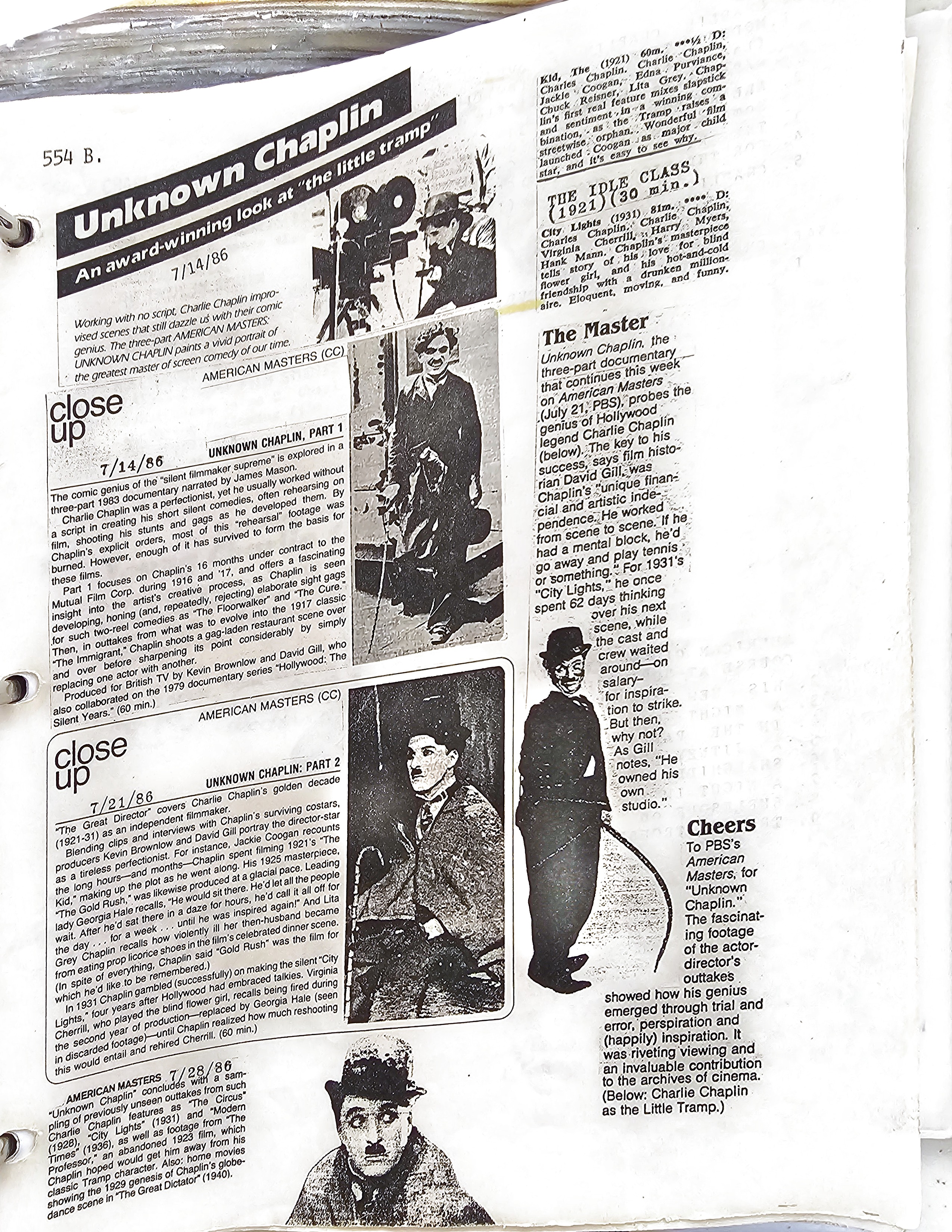
Working with no script, Charlie Chaplin improvised scenes that still dazzle us with their comic genius. The three-part AMERICAN MASTERS: UNKNOWN CHAPLIN paints a vivid portrait of the greatest master of screen comedy of our time.
AMERICAN MASTERS (CC)

close up
7/14/86
UNKNOWN CHAPLIN, PART 1
The comic genius of the "silent filmmaker supreme" is explored in a three-part 1983 documentary narrated by James Mason. Charlie Chaplin was a perfectionist, yet he usually worked without a script in creating his short silent comedies, often rehearsing on film, shooting his stunts and gags as he developed them. By Chaplin's explicit orders, most of this "rehearsal" footage was burned. However, enough of it has survived to form the basis for these films.
Part 1 focuses on Chaplin's 16 months under contract to the Mutual Film Corp. during 1916 and '17, and offers a fascinating insight into the artist's creative process, as Chaplin is seen developing, honing (and, repeatedly, rejecting) elaborate sight gags for such two-reel comedies as "The Floorwalker" and "The Cure." Then, in outtakes from what was to evolve into the 1917 classic "The Immigrant," Chaplin shoots a gag-laden restaurant scene over and over before sharpening its point considerably by simply replacing one actor with another.
Produced for British TV by Kevin Brownlow and David Gill, who also collaborated on the 1979 documentary series "Hollywood: The Silent Years." (60 min.)
AMERICAN MASTERS (CC)

close up
7/21/86
UNKNOWN CHAPLIN: PART 2
"The Great Director" covers Charlie Chaplin's golden decade (1921-31) as an independent filmmaker. Blending clips and interviews with Chaplin's surviving costars, producers Kevin Brownlow and David Gill portray the director-star as a tireless perfectionist. For instance, Jackie Coogan recounts the long hours—and months—Chaplin spent filming 1921's "The Kid," making up the plot as he went along. His 1925 masterpiece, "The Gold Rush," was likewise produced at a glacial pace. Leading lady Georgia Hale recalls, "He would sit there. He'd let all the people wait. After he'd sat there in a daze for hours, he'd call it all off for the day ... for a week ... until he was inspired again!" And Lita Grey Chaplin recalls how violently ill her then-husband became from eating prop licorice shoes in the film's celebrated dinner scene. (In spite of everything, Chaplin said "Gold Rush" was the film for which he'd like to be remembered.)
In 1931 Chaplin gambled (successfully) on making the silent "City Lights," four years after Hollywood had embraced talkies. Virginia Cherrill, who played the blind flower girl, recalls being fired during the second year of production—replaced by Georgia Hale (seen in discarded footage)—until Chaplin realized how much reshooting this would entail and rehired Cherrill. (60 min.)

AMERICAN MASTERS 7/28/86
"Unknown Chaplin" concludes with a sampling of previously unseen outtakes from such Charlie Chaplin features as "The Circus" (1928), "City Lights" (1931) and "Modern Times" (1936), as well as footage from "The Professor," an abandoned 1923 film, which Chaplin hoped would get him away from his classic Tramp character. Also: home movies showing the 1929 genesis of Chaplin's globe-dance scene in "The Great Dictator" (1940).

## RIGHT COLUMN
Kid, The (1921) 60m. ***½; D: Charles Chaplin, Charlie Chaplin, Jackie Coogan, Edna Purviance, Chuck Reisner, Lita Grey. Chaplin's first real feature mixes slapstick and sentiment in a winning combination, as the Tramp raises a streetwise orphan. Wonderful film launched Coogan as major child star, and it's easy to see why.

THE IDLE CLASS
(1921) (30 min.)
City Lights (1931) 81m. ****; D: Charles Chaplin, Charlie Chaplin, Virginia Cherrill, Harry Myers, Hank Mann. Chaplin's masterpiece tells story of his love for blind flower girl, and his hot-and-cold friendship with a drunken millionaire. Eloquent, moving, and funny.

The Master
Unknown Chaplin, the three-part documentary that continues this week on American Masters (July 21, PBS), probes the genius of Hollywood legend Charlie Chaplin (below). The key to his success, says film historian David Gill, was Chaplin's "unique financial and artistic independence. He worked from scene to scene. If he had a mental block, he'd go away and play tennis or something." For 1931's "City Lights," he once spent 62 days thinking over his next scene, while the cast and crew waited around—on salary—for inspiration to strike. But then, why not? As Gill notes, "He owned his own studio."

Cheers
To PBS's American Masters, for "Unknown Chaplin." The fascinating footage of the actor-director's outtakes showed how his genius emerged through trial and error, perspiration and (happily) inspiration. It was riveting viewing and an invaluable contribution to the archives of cinema. (Below: Charlie Chaplin as the Little Tramp.)