The first RADIO BROADCAST rr1/20260912_121825
Tapes on this page: 0 new (no reel numbers on this page)
Tap the image to open it full size
Transcription (raw)
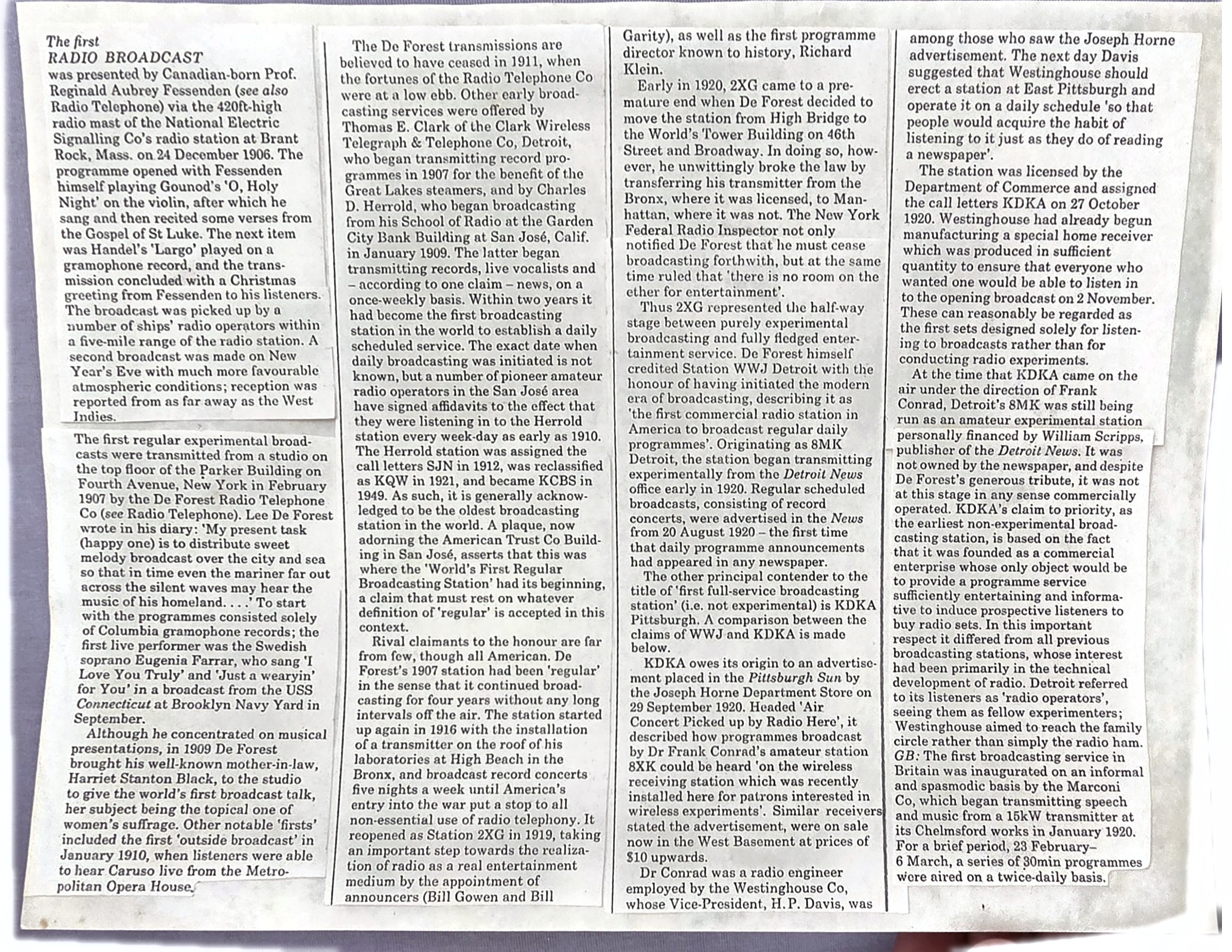
## HEADING: The first RADIO BROADCAST
## LEFT COLUMN
was presented by Canadian-born Prof.
Reginald Aubrey Fessenden (see also
Radio Telephone) via the 420ft-high
radio mast of the National Electric
Signalling Co's radio station at Brant
Rock, Mass. on 24 December 1906. The
programme opened with Fessenden
himself playing Gounod's 'O, Holy
Night' on the violin, after which he
sang and then recited some verses from
the Gospel of St Luke. The next item
was Handel's 'Largo' played on a
gramophone record, and the trans-
mission concluded with a Christmas
greeting from Fessenden to his listeners.
The broadcast was picked up by a
number of ships' radio operators within
a five-mile range of the radio station. A
second broadcast was made on New
Year's Eve with much more favourable
atmospheric conditions; reception was
reported from as far away as the West
Indies.

The first regular experimental broad-
casts were transmitted from a studio on
the top floor of the Parker Building on
Fourth Avenue, New York in February
1907 by the De Forest Radio Telephone
Co (see Radio Telephone). Lee De Forest
wrote in his diary: 'My present task
(happy one) is to distribute sweet
melody broadcast over the city and sea
so that in time even the mariner far out
across the silent waves may hear the
music of his homeland. ...' To start
with the programmes consisted solely
of Columbia gramophone records; the
first live performer was the Swedish
soprano Eugenia Farrar, who sang 'I
Love You Truly' and 'Just a wearyin'
for You' in a broadcast from the USS
Connecticut at Brooklyn Navy Yard in
September.

Although he concentrated on musical
presentations, in 1909 De Forest
brought his well-known mother-in-law,
Harriet Stanton Black, to the studio
to give the world's first broadcast talk,
her subject being the topical one of
women's suffrage. Other notable 'firsts'
included the first 'outside broadcast' in
January 1910, when listeners were able
to hear Caruso live from the Metro-
politan Opera House.

The De Forest transmissions are
believed to have ceased in 1911, when
the fortunes of the Radio Telephone Co
were at a low ebb. Other early broad-
casting services were offered by
Thomas E. Clark of the Clark Wireless
Telegraph & Telephone Co, Detroit,
who began transmitting record pro-
grammes in 1907 for the benefit of the
Great Lakes steamers, and by Charles
D. Herrold, who began broadcasting
from his School of Radio at the Garden
City Bank Building at San José, Calif.
in January 1909. The latter began
transmitting records, live vocalists and
- according to one claim - news, on a
once-weekly basis. Within two years it
had become the first broadcasting
station in the world to establish a daily
scheduled service. The exact date when
daily broadcasting was initiated is not
known, but a number of pioneer amateur
radio operators in the San José area
have signed affidavits to the effect that
they were listening in to the Herrold
station every week-day as early as 1910.
The Herrold station was assigned the
call letters SJN in 1912, was reclassified
as KQW in 1921, and became KCBS in
1949. As such, it is generally acknow-
ledged to be the oldest broadcasting
station in the world. A plaque, now
adorning the American Trust Co Build-
ing in San José, asserts that this was
where the 'World's First Regular
Broadcasting Station' had its beginning,
a claim that must rest on whatever
definition of 'regular' is accepted in this
context.

Rival claimants to the honour are far
from few, though all American. De
Forest's 1907 station had been 'regular'
in the sense that it continued broad-
casting for four years without any long
intervals off the air. The station started
up again in 1916 with the installation
of a transmitter on the roof of his
laboratories at High Beach in the
Bronx, and broadcast record concerts
five nights a week until America's
entry into the war put a stop to all
non-essential use of radio telephony. It
reopened as Station 2XG in 1919, taking
an important step towards the realiza-
tion of radio as a real entertainment
medium by the appointment of
announcers (Bill Gowen and Bill

## RIGHT COLUMN
Garity), as well as the first programme
director known to history, Richard
Klein.

Early in 1920, 2XG came to a pre-
mature end when De Forest decided to
move the station from High Bridge to
the World's Tower Building on 46th
Street and Broadway. In doing so, how-
ever, he unwittingly broke the law by
transferring his transmitter from the
Bronx, where it was licensed, to Man-
hattan, where it was not. The New York
Federal Radio Inspector not only
notified De Forest that he must cease
broadcasting forthwith, but at the same
time ruled that 'there is no room on the
ether for entertainment'.

Thus 2XG represented the half-way
stage between purely experimental
broadcasting and fully fledged enter-
tainment service. De Forest himself
credited Station WWJ Detroit with the
honour of having initiated the modern
era of broadcasting, describing it as
'the first commercial radio station in
America to broadcast regular daily
programmes'. Originating as 8MK
Detroit, the station began transmitting
experimentally from the Detroit News
office early in 1920. Regular scheduled
broadcasts, consisting of record
concerts, were advertised in the News
from 20 August 1920 - the first time
that daily programme announcements
had appeared in any newspaper.

The other principal contender to the
title of 'first full-service broadcasting
station' (i.e. not experimental) is KDKA
Pittsburgh. A comparison between the
claims of WWJ and KDKA is made
below.

KDKA owes its origin to an advertise-
ment placed in the Pittsburgh Sun by
the Joseph Horne Department Store on
29 September 1920. Headed 'Air
Concert Picked up by Radio Here', it
described how programmes broadcast
by Dr Frank Conrad's amateur station
8XK could be heard 'on the wireless
receiving station which was recently
installed here for patrons interested in
wireless experiments'. Similar receivers
stated the advertisement, were on sale
now in the West Basement at prices of
$10 upwards.

Dr Conrad was a radio engineer
employed by the Westinghouse Co,
whose Vice-President, H.P. Davis, was
among those who saw the Joseph Horne
advertisement. The next day Davis
suggested that Westinghouse should
erect a station at East Pittsburgh and
operate it on a daily schedule 'so that
people would acquire the habit of
listening to it just as they do of reading
a newspaper'.

The station was licensed by the
Department of Commerce and assigned
the call letters KDKA on 27 October
1920. Westinghouse had already begun
manufacturing a special home receiver
which was produced in sufficient
quantity to ensure that everyone who
wanted one would be able to listen in
to the opening broadcast on 2 November.
These can reasonably be regarded as
the first sets designed solely for listening
to broadcasts rather than for
conducting radio experiments.

At the time that KDKA came on the
air under the direction of Frank
Conrad, Detroit's 8MK was still being
run as an amateur experimental station
personally financed by William Scripps,
publisher of the Detroit News. It was
not owned by the newspaper, and despite
De Forest's generous tribute, it was not
at this stage in any sense commercially
operated. KDKA's claim to priority, as
the earliest non-experimental broad-
casting station, is based on the fact that
it was founded as a commercial
enterprise whose only object would be
to provide a programme service
sufficiently entertaining and informa-
tive to induce prospective listeners to
buy radio sets. In this important
respect it differed from all previous
broadcasting stations, whose interest
had been primarily in the technical
development of radio. Detroit referred
to its listeners as 'radio operators',
seeing them as fellow experimenters;
Westinghouse aimed to reach the family
circle rather than simply the radio ham.

GB: The first broadcasting service in
Britain was inaugurated on an informal
and spasmodic basis by the Marconi
Co, which began transmitting speech
and music from a 15kW transmitter at
its Chelmsford works in January 1920.
For a brief period, 23 February-
6 March, a series of 30min programmes
were aired on a twice-daily basis.