THE ARTS ENTERTAINMENT batch9/20260909_111647
Tapes on this page: 0 new (no reel numbers on this page)
Tap the image to open it full size
Transcription (raw)
## HEADING: THE ARTS ENTERTAINMENT
## LEFT COLUMN
Never Gonna Dance Again
Fred Astaire hangs up his top hat: 1899-1987
All right, wrap up the 20th century; Fred Astaire is gone. Not only was he the greatest entertainer of the century that his birth preceded by just a few months, but he was one of those inexplicable gifts of nature, an artist who leaps over boundaries, changes our nervous systems, creates a new language, transmits new kinds of joy to our startled senses and spirits. Did any artist ever bring more pure joy to more people than Fred Astaire? His only rival for that honor is Charlie Chaplin. Like Chaplin, Astaire vaulted the line between "popular" and "high" art. All his life he modestly claimed he was just a hooper, but that's not how hoofers like Rudolf Nureyev, Margot Fonteyn and Mikhail Baryshnikov saw it. What they saw was genius, and George Balanchine, the supreme choreographer, not only called Astaire the greatest dancer of all time, but compared him to Bach, saying, "Astaire has the same concentration of genius." Baryshnikov summed it up on a more practical level when he said: "No dancer can watch Fred Astaire and not know that we should have been in another business."
Now is the time to cut through the congealed clichés about Astaire: graceful, elegant, urbane, debonair, carefree. His friend James Cagney once said to him: "You know, you so-and-so, you've got a little of the hoodlum in you." It took Cagney, the Astaire of tough guys, to see the toughness behind the white tie and tails. Astaire toiled hours, days, weeks, months to achieve that elegant insouciance. After 40 takes of the wonderful "Never Gonna Dance" duet in "Swing Time," Ginger Rogers had bleeding feet. Alan Jay Lerner recalled how Astaire would work "three or four days on two bars of music."
Physical wit: Another misleading cliché about Astaire is "asexual." True, there are no mouth-chomping clinches in his pictures. But his classic films with Ginger Rogers are "chapters in a single epic romance," as Arlene Croce puts it in "The Fred Astaire and Ginger Rogers Book," the best thing ever written on the subject. The dance numbers are the love scenes in these movies, and they are charged with a high-voltage erotic lyricism that has never been matched. These numbers project a sweet and powerful sense of lovers' bodies in all the modulations of their energy, dignity and something that can only be called physical wit. Astaire's small, lean frame becomes an infinitely plastic medium
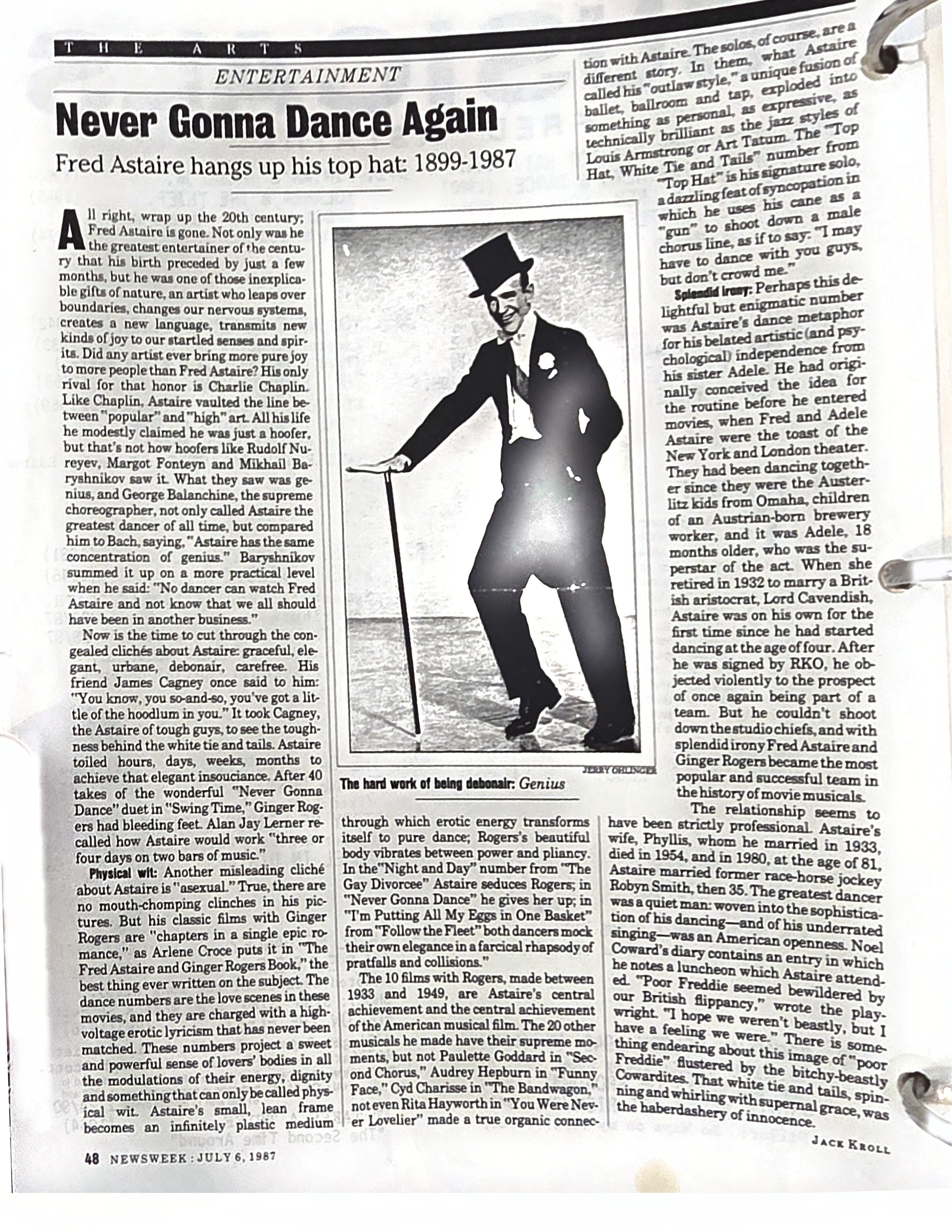
The hard work of being debonair: Genius
through which erotic energy transforms itself to pure dance; Rogers's beautiful body vibrates between power and pliancy. In the "Night and Day" number from "The Gay Divorcee" Astaire seduces Rogers; in "Never Gonna Dance" he gives her up; in "I'm Putting All My Eggs in One Basket" from "Follow the Fleet" both dancers mock their own elegance in a farcical rhapsody of pratfalls and collisions.
The 10 films with Rogers, made between 1933 and 1949, are Astaire's central achievement and the central achievement of the American musical film. The 20 other musicals he made have their supreme moments, but not Paulette Goddard in "Second Chorus," Audrey Hepburn in "Funny Face," Cyd Charisse in "The Bandwagon," not even Rita Hayworth in "You Were Never Lovelier" made a true organic connection with Astaire. The solos, of course, are a different story. In them, what he called his "outlaw style," a unique fusion of ballet, ballroom and tap, exploded into something as personal, as expressive, as technically brilliant as the jazz styles of Louis Armstrong or Art Tatum. The "Top Hat, White Tie and Tails" number from "Top Hat" is his signature solo, a dazzling feat of syncopation in which he uses his cane as a "gun" to shoot down a male chorus line, as if to say: "I may have to dance with you guys, but don't crowd me."
Splendid irony: Perhaps this delightful but enigmatic number was Astaire's dance metaphor for his belated artistic (and psychological) independence from his sister Adele. He had originally conceived the idea for the routine before he entered movies, when Fred and Adele Astaire were the toast of the New York and London theater. They had been dancing together since they were the Austerlitz kids from Omaha, children of an Austrian-born brewery worker, and it was Adele, 18 months older, who was the superstar of the act. When she retired in 1932 to marry a British aristocrat, Lord Cavendish, Astaire was on his own for the first time since he had started dancing at the age of four. After he was signed by RKO, he objected violently to the prospect of once again being part of a team. But he couldn't shoot down the studio chiefs, and with splendid irony Fred Astaire and Ginger Rogers became the most popular and successful team in the history of movie musicals.
The relationship seems to have been strictly professional. Astaire's wife, Phyllis, whom he married in 1933, died in 1954, and in 1980, at the age of 81, Astaire married former race-horse jockey Robyn Smith, then 35. The greatest dancer was a quiet man: woven into the sophistication of his dancing—and of his underrated singing—was an American openness. Noel Coward's diary contains an entry in which he notes a luncheon which Astaire attended. "Poor Freddie seemed bewildered by our British flippancy," wrote the playwright. "I hope we weren't beastly, but I have a feeling we were." There is something endearing about this image of "poor Freddie" flustered by the bitchy-beastly Cowardites. That white tie and tails, spinning and whirling with supernal grace, was the haberdashery of innocence.
JACK KROLL
48 NEWSWEEK : JULY 6, 1987