Structured entries
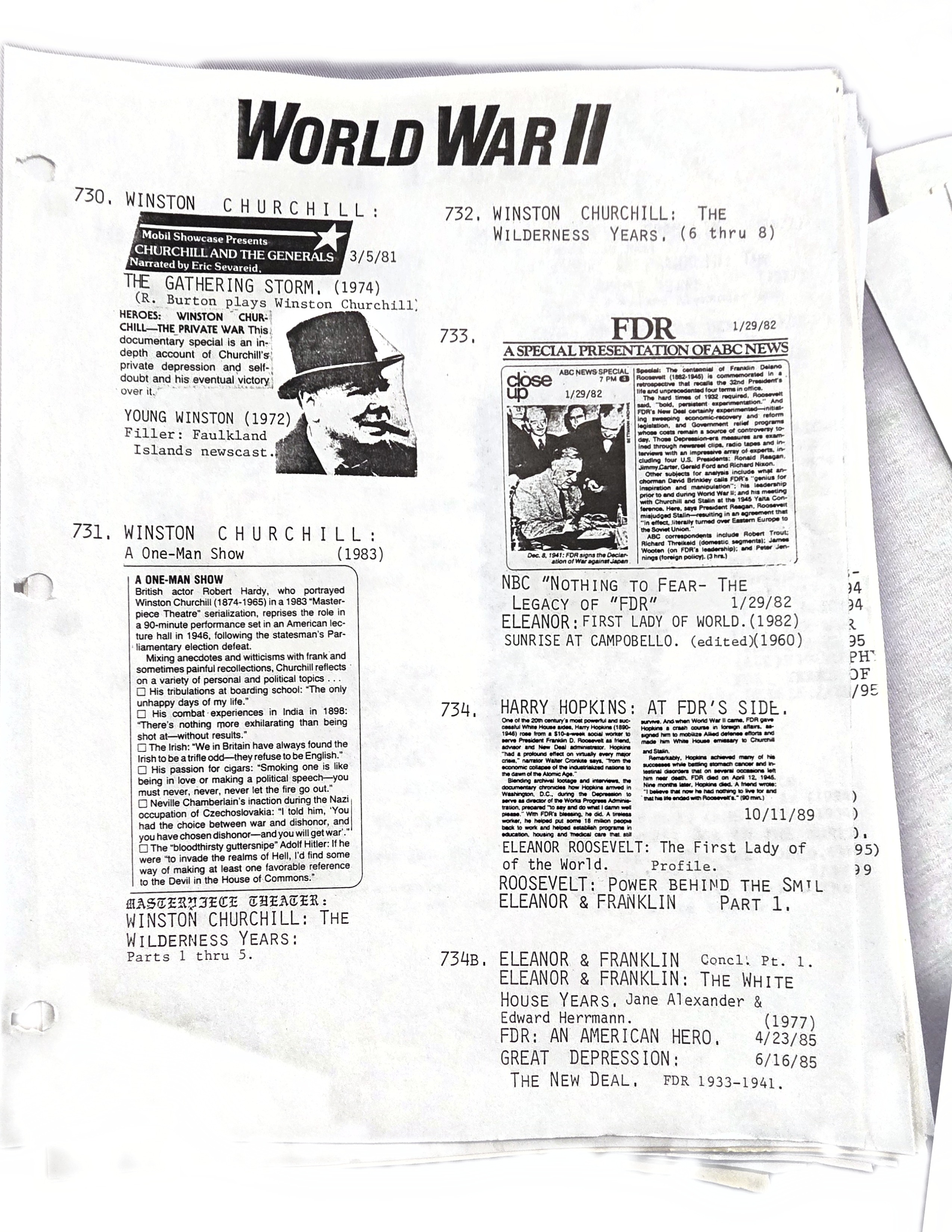
- CHURCHILL AND THE GENERALS
3/5/81
w/ Eric Sevareid
Mobil Showcase Presents; Narrated by Eric Sevareid.
- THE GATHERING STORM
(1974)
w/ R. Burton
(R. Burton plays Winston Churchill)
- HEROES: WINSTON CHURCHILL-THE PRIVATE WAR
This documentary special is an in-depth account of Churchill's private depression and self-doubt and his eventual victory over it.
- YOUNG WINSTON
(1972)
Filler: Falkland Islands newscast.
- A One-Man Show
(1983)
w/ Robert Hardy
A ONE-MAN SHOW; British actor Robert Hardy, who portrayed Winston Churchill (1874-1965) in a 1983 "Masterpiece Theatre" serialization, reprises the role in a 90-minute performance set in an American lecture hall in 1946, following the statesman's Parliamentary election defeat. Mixing anecdotes and witticisms with frank and sometimes painful recollections, Churchill reflects on a variety of personal and political topics ... His tribulations at boarding school: "The only unhappy days of my life." His combat experiences in India in 1898: "There's nothing more exhilarating than being shot at-without results." The Irish: "We in Britain have always found the Irish to be a trifle odd-they refuse to be English." His passion for cigars: "Smoking one is like being in love or making a political speech-you must never, never, never let the fire go out." Neville Chamberlain's inaction during the Nazi occupation of Czechoslovakia: "I told him, 'You had the choice between war and dishonor, and you have chosen dishonor-and you will get war'." The "bloodthirsty guttersnipe" Adolf Hitler: If he were "to invade the realms of Hell, I'd find some way of making at least one favorable reference to the Devil in the House of Commons."
- WINSTON CHURCHILL: THE WILDERNESS YEARS
MASTERPIECE THEATER; Parts 1 thru 5.
- WINSTON CHURCHILL: THE WILDERNESS YEARS
(6 thru 8)
- FDR
1/29/82
A SPECIAL PRESENTATION OF ABC NEWS; close up; ABC NEWS SPECIAL 7 PM
- NBC "NOTHING TO FEAR- THE LEGACY OF "FDR"
1/29/82
Special: The centennial of Franklin Delano Roosevelt (1882-1946) is commemorated in a retrospective that recalls the 32nd President's life and unprecedented four terms in office. The hard times of 1932 required, Roosevelt said, "bold, persistent experimentation." And FDR's New Deal certainly experimented-initiating sweeping economic-recovery and reform legislation, and Government relief programs whose costs remain a source of controversy today. Those Depression-era measures are examined through newswell clips, radio tapes and interviews with an impressive array of experts, including four U.S. Presidents: Ronald Reagan, Jimmy Carter, Gerald Ford and Richard Nixon. Other subjects for analysis include what anchorman David Brinkley calls FDR's "genius for inspiration and manipulation"; his leadership prior to and during World War II; and his meeting with Churchill and Stalin at the 1945 Yalta Conference. Here, says President Reagan, Roosevelt misjudged Stalin-resulting in an agreement that "in effect, literally turned over Eastern Europe to the Soviet Union." ABC correspondents include Robert Trout; Richard Threlkeld (domestic segments); James Wooten (on FDR's leadership); and Peter Jennings (foreign policy). (3 hrs.) Dec. 8, 1941: FDR signs the Declaration of War against Japan
- ELEANOR: FIRST LADY OF WORLD.
(1982)
- SUNRISE AT CAMPOBELLO.
(1960)
(edited)
- HARRY HOPKINS: AT FDR'S SIDE.
10/11/89
w/ Walter Cronkite
One of the 20th century's most powerful and successful White House aides, Harry Hopkins (1890-1946) rose from a $10-a-week social worker to serve President Franklin D. Roosevelt as friend, advisor and New Deal administrator. Hopkins "had a profound effect on virtually every major crisis," narrator Walter Cronkite says, "from the economic collapse of the industrialized nations to the dawn of the Atomic Age." Blending archival footage and interviews, the documentary chronicles how Hopkins arrived in Washington, D.C., during the Depression to serve as director of the Works Progress Administration, prepared "to say and do what I damn well please." With FDR's blessing, he did. A tireless worker, he helped put some 18 million people back to work and helped establish programs in education, housing and medical care that still survive. And when World War II came, FDR gave Hopkins a crash course in foreign affairs, assigned him to mobilize Allied defense efforts and made him White House emissary to Churchill and Stalin. Remarkably, Hopkins achieved many of his successes while battling stomach cancer and intestinal disorders that on several occasions left him near death. FDR died on April 12, 1945. Nine months later, Hopkins died. A friend wrote: "I believe that now he had nothing to live for and that his life ended with Roosevelt's." (90 min.)
- ELEANOR ROOSEVELT: The First Lady of the World.
Profile.
- ROOSEVELT: POWER BEHIND THE SMIL
ELEANOR & FRANKLIN PART 1.
Transcription (raw)
## HEADING: WORLD WAR II

## LEFT COLUMN
730. WINSTON CHURCHILL :
Mobil Showcase Presents
CHURCHILL AND THE GENERALS 3/5/81
Narrated by Eric Sevareid.
THE GATHERING STORM, (1974)
(R. Burton plays Winston Churchill)
HEROES: WINSTON CHUR-
CHILL-THE PRIVATE WAR This
documentary special is an in-
depth account of Churchill's
private depression and self-
doubt and his eventual victory
over it.
YOUNG WINSTON (1972)
Filler: Falkland
Islands newscast.

731. WINSTON CHURCHILL :
A One-Man Show (1983)
A ONE-MAN SHOW
British actor Robert Hardy, who portrayed
Winston Churchill (1874-1965) in a 1983 "Master-
piece Theatre" serialization, reprises the role in
a 90-minute performance set in an American lec-
ture hall in 1946, following the statesman's Par-
liamentary election defeat.
Mixing anecdotes and witticisms with frank and
sometimes painful recollections, Churchill reflects
on a variety of personal and political topics ...
His tribulations at boarding school: "The only
unhappy days of my life."
His combat experiences in India in 1898:
"There's nothing more exhilarating than being
shot at-without results."
The Irish: "We in Britain have always found the
Irish to be a trifle odd-they refuse to be English."
His passion for cigars: "Smoking one is like
being in love or making a political speech-you
must never, never, never let the fire go out."
Neville Chamberlain's inaction during the Nazi
occupation of Czechoslovakia: "I told him, 'You
had the choice between war and dishonor, and
you have chosen dishonor-and you will get war'."
The "bloodthirsty guttersnipe" Adolf Hitler: If he
were "to invade the realms of Hell, I'd find some
way of making at least one favorable reference
to the Devil in the House of Commons."

MASTERPIECE THEATER :
WINSTON CHURCHILL: THE
WILDERNESS YEARS:
Parts 1 thru 5.

## RIGHT COLUMN
732. WINSTON CHURCHILL: THE
WILDERNESS YEARS, (6 thru 8)

733. FDR 1/29/82
A SPECIAL PRESENTATION OF ABC NEWS
close up ABC NEWS SPECIAL 7 PM 1/29/82
Special: The centennial of Franklin Delano
Roosevelt (1882-1946) is commemorated in a
retrospective that recalls the 32nd President's
life and unprecedented four terms in office.
The hard times of 1932 required, Roosevelt
said, "bold, persistent experimentation." And
FDR's New Deal certainly experimented-initiat-
ing sweeping economic-recovery and reform
legislation, and Government relief programs
whose costs remain a source of controversy to-
day. Those Depression-era measures are exam-
ined through newswell clips, radio tapes and in-
terviews with an impressive array of experts, in-
cluding four U.S. Presidents: Ronald Reagan,
Jimmy Carter, Gerald Ford and Richard Nixon.
Other subjects for analysis include what an-
chorman David Brinkley calls FDR's "genius for
inspiration and manipulation"; his leadership
prior to and during World War II; and his meeting
with Churchill and Stalin at the 1945 Yalta Con-
ference. Here, says President Reagan, Roosevelt
misjudged Stalin-resulting in an agreement that
"in effect, literally turned over Eastern Europe to
the Soviet Union."
ABC correspondents include Robert Trout;
Richard Threlkeld (domestic segments); James
Wooten (on FDR's leadership); and Peter Jen-
nings (foreign policy). (3 hrs.)
Dec. 8, 1941: FDR signs the Decla-
ration of War against Japan

NBC "NOTHING TO FEAR- THE
LEGACY OF "FDR" 1/29/82
ELEANOR: FIRST LADY OF WORLD. (1982)
SUNRISE AT CAMPOBELLO. (edited)(1960)

734. HARRY HOPKINS: AT FDR'S SIDE.
One of the 20th century's most powerful and suc-
cessful White House aides, Harry Hopkins (1890-
1946) rose from a $10-a-week social worker to
serve President Franklin D. Roosevelt as friend,
advisor and New Deal administrator. Hopkins
"had a profound effect on virtually every major
crisis," narrator Walter Cronkite says, "from the
economic collapse of the industrialized nations to
the dawn of the Atomic Age."
Blending archival footage and interviews, the
documentary chronicles how Hopkins arrived in
Washington, D.C., during the Depression to
serve as director of the Works Progress Adminis-
tration, prepared "to say and do what I damn well
please." With FDR's blessing, he did. A tireless
worker, he helped put some 18 million people
back to work and helped establish programs in
education, housing and medical care that still
survive. And when World War II came, FDR gave
Hopkins a crash course in foreign affairs, as-
signed him to mobilize Allied defense efforts and
made him White House emissary to Churchill
and Stalin.
Remarkably, Hopkins achieved many of his
successes while battling stomach cancer and intes-
tinal disorders that on several occasions left
him near death. FDR died on April 12, 1945.
Nine months later, Hopkins died. A friend wrote:
"I believe that now he had nothing to live for and
that his life ended with Roosevelt's." (90 min.)
10/11/89

ELEANOR ROOSEVELT: The First Lady of
of the World. Profile.
ROOSEVELT: POWER BEHIND THE SMIL
ELEANOR & FRANKLIN PART 1.

734B. ELEANOR & FRANKLIN Concl. Pt. 1.
ELEANOR & FRANKLIN: THE WHITE
HOUSE YEARS. Jane Alexander &
Edward Herrmann. (1977)
FDR: AN AMERICAN HERO. 4/23/85
GREAT DEPRESSION: 6/16/85
THE NEW DEAL. FDR 1933-1941.