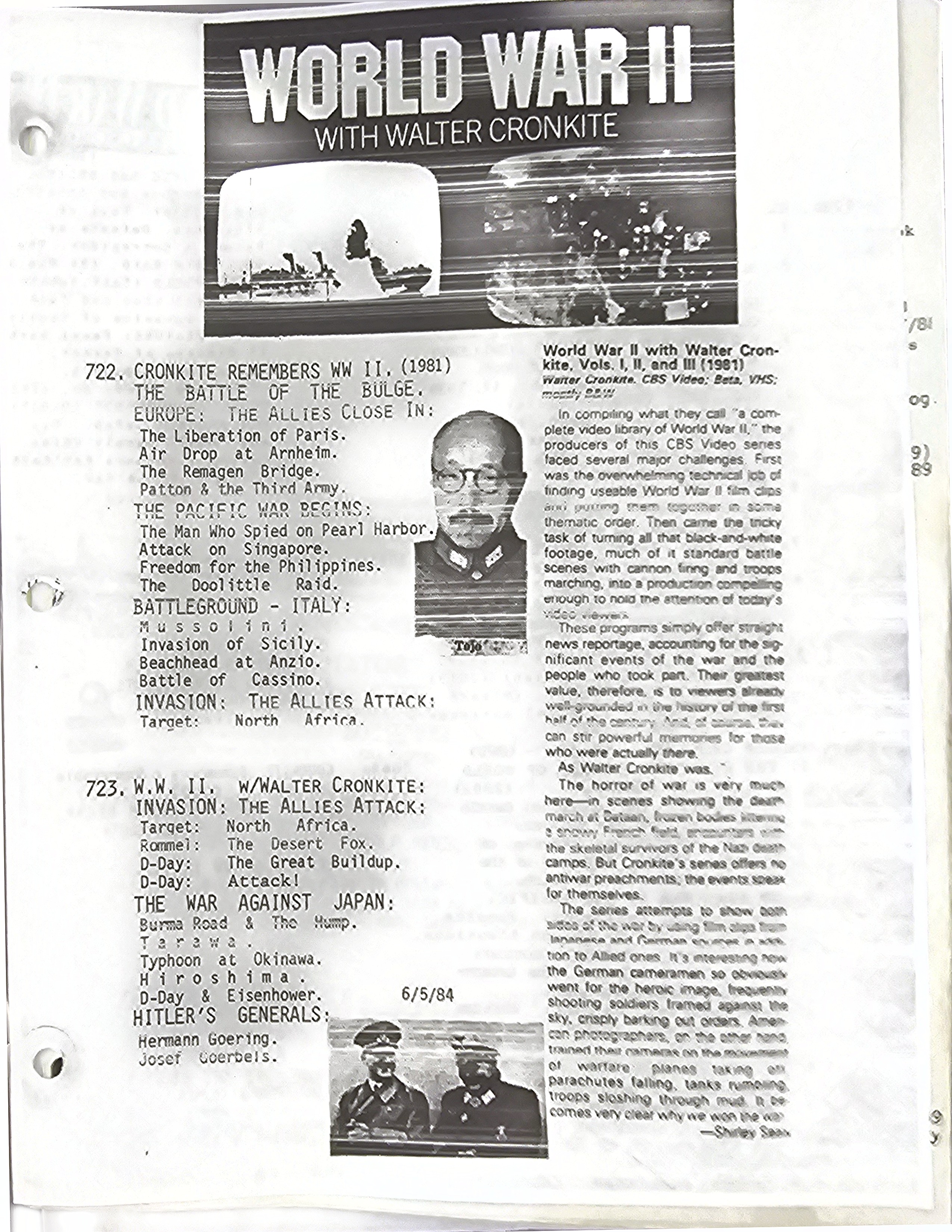
Structured entries
- CRONKITE REMEMBERS WW II
(1981)
- THE BATTLE OF THE BULGE.
- The Liberation of Paris.
- Air Drop at Arnhem.
- The Remagen Bridge.
- Patton & the Third Army.
- The Man Who Spied on Pearl Harbor.
- Attack on Singapore.
- Freedom for the Philippines.
- The Doolittle Raid.
- Mussolini.
- Invasion of Sicily.
- Beachhead at Anzio.
- Battle of Cassino.
- Target: North Africa.
- W.W. II
6/5/84
w/ Walter Cronkite
- INVASION: THE ALLIES ATTACK:
- Target: North Africa.
- Rommel: The Desert Fox.
- D-Day: The Great Buildup.
- D-Day: Attack!
- Burma Road & The Hump.
- Tarawa.
- Typhoon at Okinawa.
- Hiroshima.
- D-Day & Eisenhower.
- Hermann Goering.
- Josef Goerbels.
Transcription (raw)
## HEADING: WORLD WAR II WITH WALTER CRONKITE

## LEFT COLUMN
722. CRONKITE REMEMBERS WW II. (1981)
THE BATTLE OF THE BULGE.
EUROPE: THE ALLIES CLOSE IN:
The Liberation of Paris.
Air Drop at Arnhem.
The Remagen Bridge.
Patton & the Third Army.
THE PACIFIC WAR BEGINS:
The Man Who Spied on Pearl Harbor.
Attack on Singapore.
Freedom for the Philippines.
The Doolittle Raid.
BATTLEGROUND - ITALY:
Mussolini.
Invasion of Sicily.
Beachhead at Anzio.
Battle of Cassino.
INVASION: THE ALLIES ATTACK:
Target: North Africa.

723. W.W. II, W/WALTER CRONKITE:
INVASION: THE ALLIES ATTACK:
Target: North Africa.
Rommel: The Desert Fox.
D-Day: The Great Buildup.
D-Day: Attack!
THE WAR AGAINST JAPAN:
Burma Road & The Hump.
Tarawa.
Typhoon at Okinawa.
Hiroshima.
D-Day & Eisenhower.
6/5/84
HITLER'S GENERALS:
Hermann Goering.
Josef Goerbels.

## RIGHT COLUMN
World War II with Walter Cronkite, Vols. I, II, and III (1981)
Walter Cronkite. CBS Video; Beta, VHS; mostly B&W

In compiling what they call "a complete video library of World War II," the producers of this CBS Video series faced several major challenges. First was the overwhelming technical job of finding useable World War II film clips and putting them together in some thematic order. Then came the tricky task of turning all that black-and-white footage, much of it standard battle scenes with cannon firing and troops marching, into a production compelling enough to hold the attention of today's video viewers.

These programs simply offer straight news reportage, accounting for the significant events of the war and the people who took part. Their greatest value, therefore, is to viewers already well-grounded in the history of the first half of the century. And, of course, they can stir powerful memories for those who were actually there.

As Walter Cronkite was.

The horror of war is very much here—in scenes showing the death march at Bataan, frozen bodies littering a snowy French field, encounters with the skeletal survivors of the Nazi death camps. But Cronkite's series offers no antiwar preachments; the events speak for themselves.

The series attempts to show both sides of the war by using film clips from Japanese and German sources in addition to Allied ones. It's interesting how the German cameraman so obviously want for the heroic image, frequently shooting soldiers framed against the sky, crisply barking out orders. American photographers, on the other hand, trained their cameras on the movement of warfare: planes taking off, parachutes falling, tanks rumbling, troops sloshing through mud. It becomes very clear why we won the war.

—Shirley Seab