Structured entries
- ELOPMENT ON HORSEBACK
- STRANGE ADVENTURES OF NEW YORK DRUMMER
- UNCLE JOSH'S NIGHTMARE
(1900)
- TERRIBLE TEDDY, THE GRIZZLY KING
(1901)
- LOVE BY THE LIGHT OF THE MOON
(1901)
- CIRCULAR PANORAMA OF ELECTRIC TOWER
(1901)
- PANORAMA OF ESPLANADE BY NIGHT
(1901)
- MARTYRED PRESIDENTS
(1901)
- UNCLE JOSH AT THE MOVING PICTURE SHOW
(1902)
- THE TWENTIETH CENTURY TRAMP
(1902)
- FUN IN A BAKER SHOP
(1902)
- JACK AND THE BEANSTALK
(1902)
- LIFE OF AN AMERICAN FIREMAN
(1903)
- UNCLE TOM'S CABIN
(1903)
- THE GAY SHOE CLERK
(1903)
- A ROMANCE OF THE RAIL
(1903)
- ROUNDING UP OF THE "YEGGMEN"
(1904)
- EUROPEAN REST CURE
(1904)
- THE EX-CONVICT
(1904)
- THE KLEPTOMANIAC
(1905)
- THE SEVEN AGES
(1905)
- HOW JONES LOST HIS ROLL
(1905)
- THE WHOLE DAM FAMILY AND THE DAM DOG
(1905)
- THE DUDE AND THE BURGLAR
(1903)
- THE STORY THE BIOGRAPH TOLD
(1904)
- PERSONAL
(1904)
- THE WIDOW AND THE ONLY MAN
(1904)
- THE LOST CHILD
(1904)
- THE SUBURBANITE
(1904)
- TOM, TOM, THE PIPER'S SON
(1905)
- AN ACADIAN ELOPEMENT
(1907)
- GRANDPA'S READING GLASS
(1902)
- MR. HURRY-UP OF NEW YORK
(1907)
- THE TIRED TAILOR'S DREAM
(1907)
- THE SCULPTOR'S NIGHTMARE
(1908)
- A SEARCH FOR EVIDENCE
(1903)
- THE MOONSHINER
(1904)
- THE HERO OF LIAO YANG
(1904)
- THE NIHILISTS
(1905)
- THE GREAT JEWEL MYSTERY
(1905)
- A KENTUCKY FEUD
(1905)
- THE SILVER WEDDING
(1906)
- THE BLACK HAND
(1906)
- THE PAYMASTER
(1906)
- THE TUNNEL WORKERS
(1906)
- THE SKYSCRAPERS
(1906)
- THE BOY DETECTIVE
(1908)
- HER FIRST ADVENTURE
(1908)
- CAUGHT BY WIRELESS
(1908)
- AT THE FRENCH BALL
(1908)
- BALKED AT THE ALTAR
(1908)
- FAITHFUL
(1910)
- A DASH THROUGH THE CLOUDS
(1912)
- A CALAMITOUS ELOPEMENT
(1908)
- WHERE BREAKERS ROAR
(1908)
- AN AWFUL MOMENT
(1908)
- THE CORD OF LIFE
(1909)
- THE GIRLS AND DADDY
(1909)
- THE GOLDEN LOUIS
(1909)
- AT THE ALTAR
(1909)
- FOOLS OF FATE
(1909)
Transcription (raw)
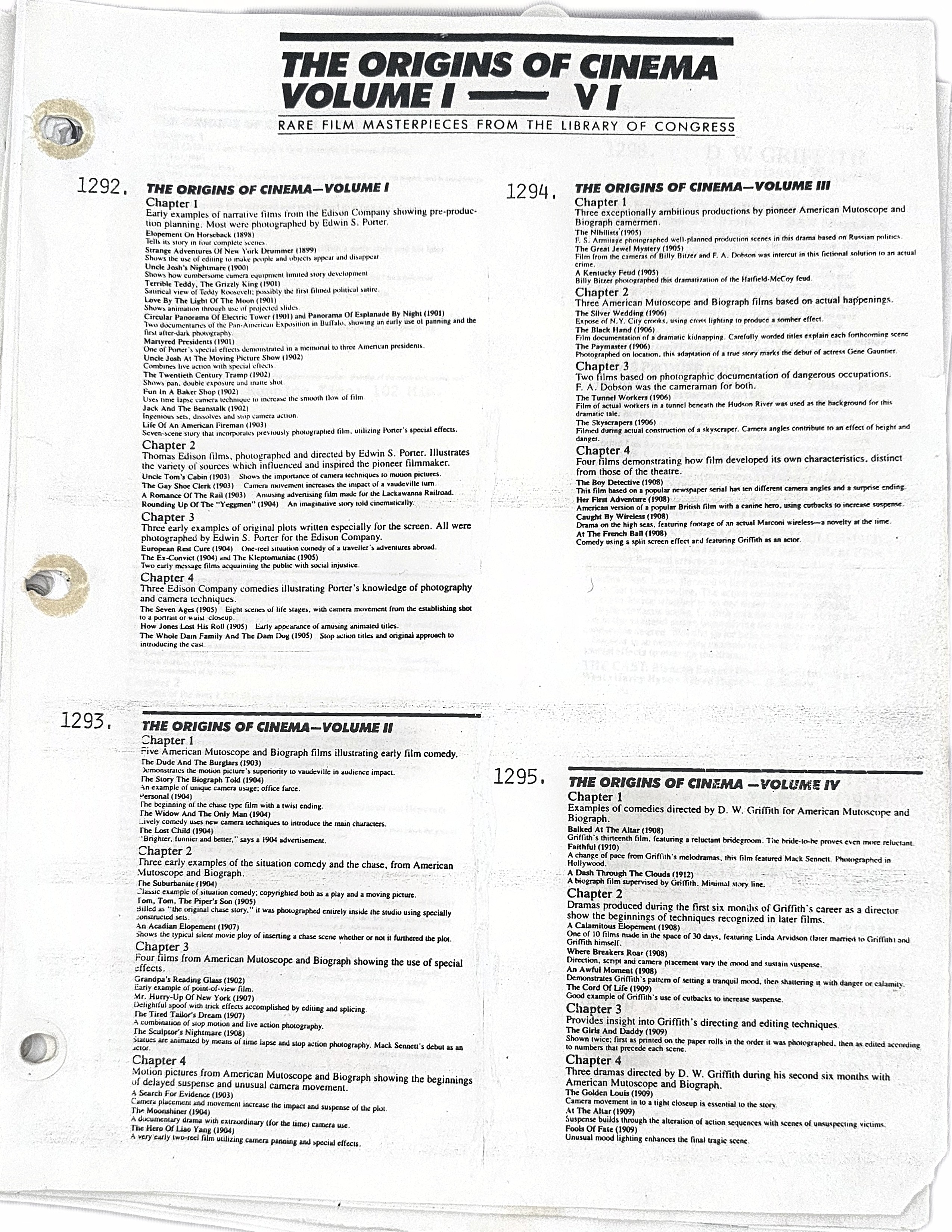
## HEADING: THE ORIGINS OF CINEMA VOLUME I — VI RARE FILM MASTERPIECES FROM THE LIBRARY OF CONGRESS

## LEFT COLUMN
1292. THE ORIGINS OF CINEMA—VOLUME I
Chapter 1
Early examples of narrative films from the Edison Company showing pre-production planning. Most were photographed by Edwin S. Porter.
Elopement On Horseback (1898)
Tells its story in four complete scenes.
Strange Adventures Of New York Drummer (1899)
Shows the use of editing to make people and objects appear and disappear
Uncle Josh's Nightmare (1900)
Shows how cumbersome camera equipment limited story development
Terrible Teddy, The Grizzly King (1901)
Satirical view of Teddy Roosevelt; possibly the first filmed political satire.
Love By The Light Of The Moon (1901)
Shows animation through use of projected slides
Circular Panorama Of Electric Tower (1901) and Panorama Of Esplanade By Night (1901)
Two documentaries of the Pan-American Exposition in Buffalo, showing an early use of panning and the first after-dark photography.
Martyred Presidents (1901)
One of Porter's special effects demonstrated in a memorial to three American presidents.
Uncle Josh At The Moving Picture Show (1902)
Combines live action with special effects
The Twentieth Century Tramp (1902)
Shows pan, double exposure and matte shot
Fun In A Baker Shop (1902)
Uses time lapse camera technique to increase the smooth flow of film
Jack And The Beanstalk (1902)
Ingenious sets, dissolves and stop camera action.
Life Of An American Fireman (1903)
Seven-scene story that incorporates previously photographed film, utilizing Porter's special effects.
Chapter 2
Thomas Edison films, photographed and directed by Edwin S. Porter. Illustrates the variety of sources which influenced and inspired the pioneer filmmaker.
Uncle Tom's Cabin (1903) Shows the importance of camera techniques to motion pictures.
The Gay Shoe Clerk (1903) Camera movement increases the impact of a vaudeville turn.
A Romance Of The Rail (1903) Amusing advertising film made for the Lackawanna Railroad.
Rounding Up Of The "Yeggmen" (1904) An imaginative story told cinematically.
Chapter 3
Three early examples of original plots written especially for the screen. All were photographed by Edwin S. Porter for the Edison Company.
European Rest Cure (1904) One-reel situation comedy of a traveller's adventures abroad.
The Ex-Convict (1904) and The Kleptomaniac (1905)
Two early message films acquainting the public with social injustice.
Chapter 4
Three Edison Company comedies illustrating Porter's knowledge of photography and camera techniques.
The Seven Ages (1905) Eight scenes of life stages, with camera movement from the establishing shot to a portrait or waist closeup.
How Jones Lost His Roll (1905) Early appearance of amusing animated titles.
The Whole Dam Family And The Dam Dog (1905) Stop action titles and original approach to introducing the cast.

1293. THE ORIGINS OF CINEMA—VOLUME II
Chapter 1
Five American Mutoscope and Biograph films illustrating early film comedy.
The Dude And The Burglar (1903)
Demonstrates the motion picture's superiority to vaudeville in audience impact.
The Story The Biograph Told (1904)
An example of unique camera usage; office farce.
Personal (1904)
The beginning of the chase type film with a twist ending.
The Widow And The Only Man (1904)
Lively comedy uses new camera techniques to introduce the main characters.
The Lost Child (1904)
"Brighter, funnier and better," says a 1904 advertisement.
Chapter 2
Three early examples of the situation comedy and the chase, from American Mutoscope and Biograph.
The Suburbanite (1904)
Classic example of situation comedy; copyrighted both as a play and a moving picture.
Tom, Tom, The Piper's Son (1905)
Hailed as "the original chase story," it was photographed entirely inside the studio using specially constructed sets.
An Acadian Elopement (1907)
Shows the typical silent movie ploy of inserting a chase scene whether or not it furthered the plot.
Chapter 3
Four films from American Mutoscope and Biograph showing the use of special effects.
Grandpa's Reading Glass (1902)
Early example of point-of-view film.
Mr. Hurry-Up Of New York (1907)
Delightful spoof with trick effects accomplished by editing and splicing.
The Tired Tailor's Dream (1907)
A combination of stop motion and live action photography.
The Sculptor's Nightmare (1908)
Statues are animated by means of time lapse and stop action photography. Mack Sennett's debut as an actor.
Chapter 4
Motion pictures from American Mutoscope and Biograph showing the beginnings of delayed suspense and unusual camera movement.
A Search For Evidence (1903)
Camera placement and movement increase the impact and suspense of the plot.
The Moonshiner (1904)
A documentary drama with extraordinary (for the time) camera use.
The Hero Of Liao Yang (1904)
A very early two-reel film utilizing camera panning and special effects.

## RIGHT COLUMN
1294. THE ORIGINS OF CINEMA—VOLUME III
Chapter 1
Three exceptionally ambitious productions by pioneer American Mutoscope and Biograph cameramen.
The Nihilists (1905)
F. S. Armitage photographed well-planned production scenes in this drama based on Russian politics.
The Great Jewel Mystery (1905)
Film from the cameras of Billy Bitzer and F. A. Dobson was intercut in this fictional solution to an actual crime.
A Kentucky Feud (1905)
Billy Bitzer photographed this dramatization of the Hatfield-McCoy feud.
Chapter 2
Three American Mutoscope and Biograph films based on actual happenings.
The Silver Wedding (1906)
Expose of N.Y. City crooks, using cross lighting to produce a somber effect.
The Black Hand (1906)
Film documentation of a dramatic kidnapping. Carefully worded titles explain each forthcoming scene
The Paymaster (1906)
Photographed on location, this adaptation of a true story marks the debut of actress Gene Gauntier.
Chapter 3
Two films based on photographic documentation of dangerous occupations. F. A. Dobson was the cameraman for both.
The Tunnel Workers (1906)
Film of actual workers in a tunnel beneath the Hudson River was used as the background for this dramatic tale.
The Skyscrapers (1906)
Filmed during actual construction of a skyscraper. Camera angles contribute to an effect of height and danger.
Chapter 4
Four films demonstrating how film developed its own characteristics, distinct from those of the theatre.
The Boy Detective (1908)
This film based on a popular newspaper serial has ten different camera angles and a surprise ending.
Her First Adventure (1908)
American version of a popular British film with a canine hero, using cutbacks to increase suspense.
Caught By Wireless (1908)
Drama on the high seas, featuring footage of an actual Marconi wireless—a novelty at the time.
At The French Ball (1908)
Comedy using a split screen effect and featuring Griffith as an actor.

1295. THE ORIGINS OF CINEMA—VOLUME IV
Chapter 1
Examples of comedies directed by D. W. Griffith for American Mutoscope and Biograph.
Balked At The Altar (1908)
Griffith's thirteenth film, featuring a reluctant bridegroom. The bride-to-be proves even more reluctant.
Faithful (1910)
A change of pace from Griffith's melodramas, this film featured Mack Sennett. Photographed in Hollywood.
A Dash Through The Clouds (1912)
A biograph film supervised by Griffith. Minimal story line.
Chapter 2
Dramas produced during the first six months of Griffith's career as a director show the beginnings of techniques recognized in later films.
A Calamitous Elopement (1908)
One of 10 films made in the space of 30 days, featuring Linda Arvidson (later married to Griffith) and Griffith himself.
Where Breakers Roar (1908)
Direction, script and camera placement vary the mood and sustain suspense.
An Awful Moment (1908)
Demonstrates Griffith's pattern of setting a tranquil mood, then shattering it with danger or calamity.
The Cord Of Life (1909)
Good example of Griffith's use of cutbacks to increase suspense.
Chapter 3
Provides insight into Griffith's directing and editing techniques.
The Girls And Daddy (1909)
Shown twice; first as printed on the paper rolls in the order it was photographed, then as edited according to numbers that precede each scene.
Chapter 4
Three dramas directed by D. W. Griffith during his second six months with American Mutoscope and Biograph.
The Golden Louis (1909)
Camera movement in to a tight closeup is essential to the story.
At The Altar (1909)
Suspense builds through the alteration of action sequences with scenes of unsuspecting victims.
Fools Of Fate (1909)
Unusual mood lighting enhances the final tragic scene.